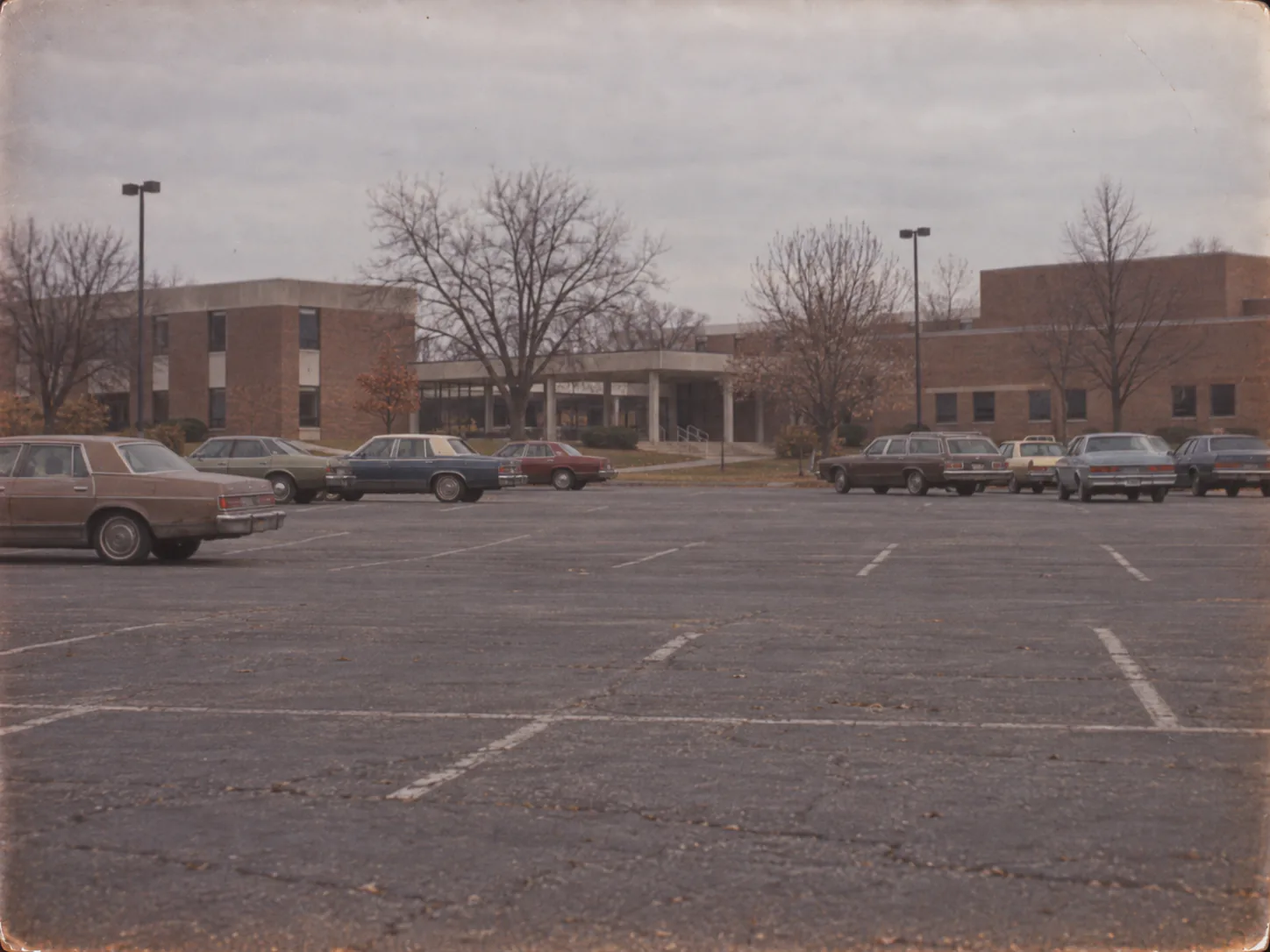
Scott Macklem was twenty years old. His murder has never been solved.
On the morning of November 5, 1986, he was shot once and killed in a parking lot at St. Clair County Community College. He was a son, a brother, and an expectant father. His death was a tragedy and his family’s grief is real. The question this page asks is whether anyone ever seriously looked for the person who killed him.
Campus security head Donna Henderson testified Macklem had no parking permit for that lot and no tickets; his presence there that morning was not predictable to an outsider.
The botched investigation
Within a day, the investigation had narrowed to one man, 450 miles away. Leads left behind, resources refused.
The case against him began with a name, and no two accounts agree on who gave it.
The paper trail begins at the hospital on the morning of the murder, and they contradict each other. Officer Jim Carmody's report from that day says the victim's fiancée's sixteen-year-old sister came to him unprompted with the name of a man she knew as John Lamar, her sister's former boyfriend, whom the family believed responsible. Sergeant John Bowns's report, written the same day about the same emergency room, credits the victim's boss instead, saying Scott had told him of a threat weeks earlier, and says nothing about the sister. Years later the boss recalled it differently, remembering that the fiancée gave the police the name. The fiancée's own account is different again: no one in her family volunteered it, an officer asked her whether she had former boyfriends, and she answered. Four accounts of the case's first hour, and no two of them match.


On the morning of the murder, the identification witness pointed out a different man.
Before Freeman was a suspect, he pointed police to another man and a plate; no one ever showed him that man's photograph.
Later on the day of the murder, the identification witness told an officer that a man he saw in the parking lot resembled the driver. He testified it was "more or less a possibility," seen from too far away "to make a positive identification." The plate he gave traced to a Florida car belonging to James Kilbourne. Det. Hudson agreed at trial that the witness had identified Kilbourne that day. Sgt. Bowns testified the witness "said he saw a man that returned to the parking lot that looked similar," and that he never showed the witness a photograph of Kilbourne: "I didn't have a picture of Mr. Kilbourne."
Nothing in the record connects James Kilbourne to this murder, and this page makes no such claim. The exchange bears on the reliability of the identification the jury was given.
No one saw the shooting.
No one saw the shooting. A student in the lot heard the blast and saw a car pass him at ordinary speed on its way out. He got a look at the driver, which he estimated at about five seconds, and about ten minutes later wrote down a plate number. It came back to a Buick sold eighteen months earlier, and he told the jury it came back wrong.
What that witness described, and what a hypnosis session did to it that same morning, has its own card below.
The one description of the driver came from a hypnosis session, and the details that matched Kensu were supplied by the hypnotist.
Start with what hypnosis does to a memory. A hypnotized witness tends to grow more confident and more suggestible at the same time, so a detail introduced by the person asking the questions can come back as if it had been remembered. That is why courts treat hypnotically assisted identification with caution, and it is what the session transcript in this case shows happening.
The witness was hypnotized on the morning of the murder by Dr. Thomas Mooney, a psychology instructor at the college who, by his own present-day account, had studied hypnosis but used it on almost no one. He recorded the session; the recording is missing, and only the transcript survives. Under hypnosis the witness described the car as “light tan in color, apparently mink color,” a foreign hatchback, and when the questioning turned to its make he was asked, in substance, whether it was an American car and answered no. The driver he described was wearing a navy ski mask worn up like a stocking cap; he said nothing about facial hair until the hypnotist asked, with no prompting, “Now he’s got a beard too?” He also described how the victim looked as he fell, though he had already said he did not see him fall.
The number he later wrote for the license plate was assembled the same way, through a run of proposed letter combinations, and it traced to a car that had nothing to do with the case. An expert who reviewed the session transcript years later called it close to the worst hypnosis session he had seen.
What the session produced, the trial then hardened. The witness told the jury, “I know it was him driving the car,” while conceding the plate “came back the wrong plate number, I know that.” Certain of the conclusion; uncertain, by his own account, of the car, the plate, and the face.
The fingerprint that excluded him was last searched in 2008.
A shotgun shell box recovered in the investigation bore a latent fingerprint. The state’s own 1986 laboratory report excluded Freeman as its source.
The box was a Federal 20-gauge shell box; the fatal round was 12-gauge (Tr. 955). The difference is a reason to test, not a reason not to.
In April 2008, at Port Huron PD’s request, the State Police searched the print through Michigan’s AFIS and the FBI’s IAFIS: no subject was developed, and the report closed with one sentence that matters now: “The latent print will remain on file.”
That was eighteen years ago. The FBI’s current system, NGI, did not exist until 2014, its latent-matching technology is a generation better, and the databases have grown by tens of millions of prints since the last search. The print is sitting in a state file with a laboratory number, waiting to be searched again.
Basic steps were never taken.
The failures began at the scene. By a witness’s account, no crime-scene tape went up for at least three quarters of an hour, on a working campus parking lot with people moving through it. The department photographed the scene roughly fifteen times. Nothing the victim was carrying was tested: not the gym bag beside his car, not the textbooks on the hood of it, not his clothing, and the jacket the first person to reach him pressed to the wound was never collected. A police report names seven young men standing in that lot the morning of the murder; the record shows no interview of any of them. The man who reached Scott Macklem first, and tried to keep him alive, got a single follow-up call a week later and was never called to testify.
Two more absences sit in the file itself. No toxicology was performed. And no interview of the victim’s brother appears in the investigative file.
Almost the whole case was built on the reports of one detective, and some of them cannot be corroborated.
Almost every police report in this case was written and submitted by one man: Sergeant John Bowns, for whom Scott Macklem’s murder was a first homicide as lead investigator. Four years before the murder, the Port Huron Police Department had terminated Bowns for misconduct and neglect of duty after the State Police caught him gambling illegally; he was later reinstated.
Herb Welser, the retired Port Huron detective lieutenant who has re-investigated this case, set out to trace Bowns’s paperwork and reached an unsettling conclusion: a number of the reports cannot be corroborated. People named in them as having been interviewed have said the interviews never happened. The motive theory that Freeman learned of the engagement at a Halloween party rests on Bowns’s reports; the people those reports place at the party do not recall speaking to police. Another detective on the case, Harry Hudson, reviewed a report bearing his own name that described interviews he and Bowns supposedly conducted together, and said they never took place.
Bowns died two decades ago. The point is not his character; it is that the documentary spine of this case is the work of a single investigator whose reports, examined four decades later, do not all hold up.
The State Police found his alibi witnesses within two weeks. Port Huron did not return the call.
Two weeks after the murder, the Michigan State Police post near Escanaba reopened its assistance file for one stated reason: the suspect “had alibi witnesses in the Escanaba area, to the fact that he had been in Escanaba on November 5, 1986.” A trooper began interviewing and listed further witnesses to contact.
The journal entries that follow tell the rest: a call to the Port Huron detective goes unreturned; then, February 11, 1987: “Reviewed, close this out.” Final disposition: “our help was not requested or needed.” The trial began ten weeks later.
Run the prints.
The identifiable print from the evidence has never matched anyone, including Kensu, whose own fingerprints have been in the databases since 1987. Port Huron's own police department last had it searched in 2008. It remains on file at the State Police laboratory. The request is to run it once on the systems that exist now. The box was a Federal 20-gauge shell box; the fatal round was 12-gauge (Tr. 864; Welser 2008 evidence review, property tag 3445). The difference is one more reason to run it. At trial, the jury heard the lifts had never been compared with him (Tr. 867).
Ask Whitmer to run the printsThe FBI has replaced the system that searched it. Running it again is a different search.
The lifts from the ammunition box were taken in 1986 and, as the detective acknowledged at trial, had never been compared with the defendant (Vol. V, archive PDF pp. 20–21). The one search ever made came in 2008: it ran on IAFIS, the FBI’s fingerprint system of that era. The FBI retired IAFIS and replaced it with Next Generation Identification, deployed in 2014, with substantially improved latent-print matching and a database that has grown by tens of millions of records since this print was last searched.
A request to run it again is a request to search the print once on the systems that exist now. It takes days and costs almost nothing. It leaves the verdict untouched.
If it matches no one, nothing is lost. If it matches someone, a forty-year-old murder moves toward being solved, which is owed to Scott Macklem before it is owed to anyone else.

Prints were lifted from the victim’s own car in 1986. There is no record of what became of them.
Det. Hudson’s own 1986 report records that he lifted latent prints from the driver’s side front quarter panel of the victim’s car. Asked about those lifts in 2008, he could not remember taking them, said he may have discarded them if the ridge structure was too thin, and offered that they “would not have been important anyways.” Whatever the explanation, the record shows prints lifted from the victim’s car in 1986 and no record of what became of them.
And the spent 12-gauge shell, the only shell of the murder weapon's gauge found in the parking lot, was never taken to a laboratory. A civilian picked it up two days after the murder, kept it three weeks, and handed it to Sgt. Bowns on November 28. Bowns acknowledged under oath that he never took it to the lab and never checked it for prints; his reason was that the markings on the casing looked inconsistent to him with what the victim was shot with. "You don't know that," Dean answered, and Bowns agreed his judgment came from what was printed on the outside (Tr. 954–55; Vol. V, archive PDF pp. 107–108).
Michigan’s integrity unit frees people when old evidence meets new testing. This case has evidence that has never been tested at all.
In 2021, testing of 1988 blood evidence freed Gilbert Poole after 32 years. His conviction rested on a confession relayed by a girlfriend and a bite-mark comparison; the DNA excluded him. The Attorney General’s own Conviction Integrity Unit asked the court to dismiss the conviction, saying the unit exists to ensure "those convicted of state crimes are in fact guilty while also providing justice to those wrongfully imprisoned." In 2023 the same unit, working jointly with the same Innocence Clinic that represents Kensu, exonerated George and Melvin DeJesus after 25 years. The pattern in both: evidence collected decades ago, met by testing that didn’t exist when it was collected.
Now the inventory here. The spent 12-gauge shell, the only shell of the murder weapon's gauge recovered from the scene, was never taken to a laboratory at all; the investigating sergeant acknowledged that under oath (Tr. 955). An ink pen with what appeared to be blood on it was in the evidence file when a retired detective inventoried it in 2008, with nothing in any police report explaining why it was there and no record of any testing. Asked under FOIA in 2022 for any record of DNA or forensic testing of the evidence in this case, the prosecutor's office answered that it possesses none. And the latent print from the ammunition box, the one exhibit that has ever been searched, was last run in April 2008 on systems the FBI has since retired.
The state’s review closed in 2022 citing no new information supporting innocence. Untested evidence is where new information comes from, and this case is not asking the unit to re-run anything. It is asking it to run, for the first time, tests its own precedents were built on.
Two people can order this search: the Attorney General and the Governor.
Michigan’s Attorney General sits atop the state’s criminal-justice information system, supervises county prosecutors by statute (MCL 14.30), and runs the Conviction Integrity Unit whose precedents are described above. The State Police laboratory holding the print answers, like every executive department, to the Governor (Mich. Const. art. V, § 8). The Governor holds the clemency power (art. V, § 14), and the laboratory that holds the print answers to her (art. V, § 8).
An unsolved murder. An innocent man serving for it. You can ask her to correct both.
Her term ends in 93 days.