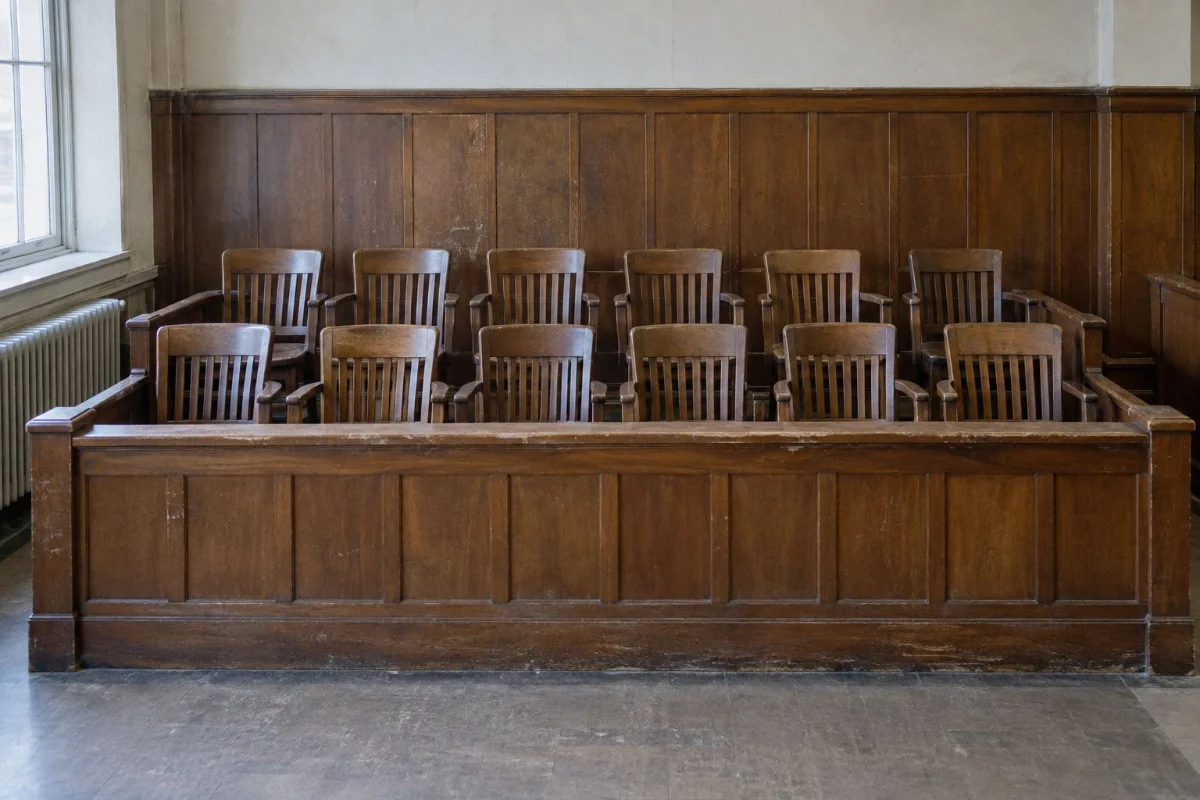
Juries are usually right.
This one was working blind.
When people first hear this case, they ask the same question: if the evidence is that thin, how was he convicted? The answer is not a mystery. There are glaring failures, each documented, each of which the jury never saw behind.
His lawyer was addicted to cocaine and alcohol during the trial.
Dean’s addiction in this era is recited in the federal record. He was later disbarred, and a court found him ineffective in another case from the same period, partly because of it.
In this trial, he did not call the one witness who covered the murder minute. And, a federal judge found, he prevented Kensu from testifying in his own defense despite Kensu doing “all that he could do” to exercise that right. The jury deciding Kensu’s fate saw neither failure; what it saw, every day of trial, was Dean.
Jurors noticed. Post-trial juror comments, reported in a private investigator’s 2001 letter to the Governor and filed in the federal court record, included this one: “his lawyer looked like a sleaze bag.... I figured anybody with a lawyer like that must be guilty.”

The exculpatory witness who could have ended it was never called to testify.
She lived with him. She covered 9:00 a.m. itself: her affidavit puts them together, 450 miles from Port Huron, at the minute of the murder. She told his lawyer before trial and has sworn to it since 1999.
She assumed she would be called; his lawyer’s office was in contact with her family before trial and knew where she was. She never was called, and a federal judge found that failure “so serious that it deprived Petitioner of a fair trial.”
The “murder confession” came from a jailhouse informant who was rewarded, and who recanted.
Philip Joplin was a repeat felon, charged as a habitual offender and facing a potential life term, awaiting return to prison when he briefly shared a holding cell with Kensu shortly before trial. Within days he had written the prosecutor a letter from jail offering testimony. At trial he told the jury that Kensu, a total stranger, had spontaneously confessed to him, and he denied receiving any promise or benefit for saying so.
In 1990, under oath, Joplin explained how that worked. The prosecutor’s office told him, formally, that “no deals were being made nor offered.” But his parole agent and a detective “both assured me… that I wasn’t going back to prison,” and the parole agent’s assurance came before he testified. He did not go back to prison. And on his release, he testified, the parole agent told him “to maintain a low profile so Freeman’s attorney wouldn’t see me.” Asked how that squared with his trial denial, he drew the distinction himself: “Was I promised any job or any leniency or early release from prison. I wasn’t promised any of that. I was told I wasn’t going to go back.”
Before his death in 1998, in videotaped interviews, including one broadcast by WXYZ-TV, he recanted entirely: the confession never happened; he had fabricated it hoping for leniency. Reviewing all of it in 2010, Judge Hood found the prosecution “should have known his testimony was untruthful.”
The jury heard the confession. It never heard the rest.
Temujin wanted to tell the jury where he was. His lawyer wouldn’t let him. A juror later said the silence looked like guilt.
A defendant’s silence is not evidence. The judge instructs the jury so, and the Constitution requires it. Jurors are human anyway, and a defendant who sits mute while nine strangers vouch for his whereabouts leaves a question hanging in the room that no instruction fully answers: why won’t he say it himself?
Kensu wanted to. He wanted to tell the jury where he was on November 5, contradict the account of the relationship, and explain the alibi in his own words. His lawyer, in the grip of the addiction documented elsewhere on this page, prevented him. In 2010 the federal court found that obstruction of his right to testify among the constitutional violations at this trial; it is one of the four grounds on which his release was ordered.
After the verdict, a juror told the Port Huron Times Herald that the alibi had seemed too perfect, and that the defendant’s failure to testify had made him look guilty. That juror did exactly what the law says jurors must not do, and did it honestly, out loud, to a reporter. It is the rare case where we know the forbidden inference was drawn, because the person who drew it said so.

The one identification of the driver came from a hypnosis session where police supplied the details.
The hypnosis session itself is in the police file, and it shows what the witness described while under. The car: “light tan in color, apparently mink color,” which he clarified as “a tannish color,” foreign, “newer, ’82, I would say,” a hatchback with a tan interior, and asked directly whether it was an American car, “No.” The driver: a navy ski mask worn up on his head like a stocking hat, a green army jacket, head down. The beard was not his. The hypnotist asked, “Now he’s got a beard too?” and the answer was “I think so,” followed by “He’s got dark hair, I know that,” and then “I think it’s visible because of the beard I think he’s got dark hair.” The plate was assembled the same way, through a run of proposed letter combinations: “D-S-O or D-H-M?”, “Are the first ones still 8-8-2?”, “is it D-S-L or D-H-L?” His own account of writing it down, given in the same session, was that he put it on his folder after class, and that when police ran the numbers he thought he had, one came back to an Oldsmobile and the other to a car in Mount Clemens with no title information.
What hypnosis produced, the trial then hardened. He wrote down a license plate as, in his words, “more or less an afterthought,” from memory, on a notebook folder later thrown out. The number traced to a Buick a jeweler had traded in eighteen months before the murder. “It came back the wrong plate number, I know that,” he testified. He also testified: “I know it was him driving the car.” Certain of the conclusion; uncertain, by his own account, of the jacket, the plate, and everything else. Pp. 1043–51, 1056–58.
Radar and fuel records could have tested the flight theory in 1986. No one ever looked.
The charter-flight theory reached the jury as a possibility with nothing behind it. What the jury did not know is that two kinds of records existed in 1986 that could have turned the possibility into a fact or ruled it out: FAA flight data, and the fuel-sale records kept at the airports themselves. Both were obtainable by request. The state, which carried the burden of proof, never requested either.
Harvey Setter managed the Delta County Airport, the airport serving Escanaba, from 1982 to 1999. In his letter to the Governor he states that “FAA radar would have picked up any flight from Delta County to St. Clair County,” and that in nearly four decades, no one from the state ever contacted him about one.
Rick Orzel owned the fixed-base operation at the St. Clair County Airport, on the Port Huron end, from 1983 to 2013, and he sold the fuel any such flight would have needed. He “had records of every fuel sale that could have been checked if anyone had asked me before I purged nearly all those old documents about 15 years ago.” He also knew the state’s pilot witness “quite well,” and writes that the testimony about walk-in night charters is something “I know, due to my professional experience and expertise, to be false.”
Both men say the first contact anyone ever made about this case was the Innocence Clinic’s call, decades after trial. This is the shape of how it happened: the theory that bridged 450 miles was put in front of the jury unchecked, the checks sat in filing cabinets at both ends of the route, and by the time anyone asked the question, part of the answer had been thrown away unread.
In the photos police showed the witnesses, his picture stood out from all the others. The jury was shown a different version.
No one saw the shooting. The people who identified Kensu had never met him. One saw a man in a different parking lot an hour before the murder. The other watched a passing driver through a car window, for what he estimated at about five seconds. When a witness is identifying a total stranger glimpsed once, the identification is only as good as the way police ask the question.
Here is how police asked it. Two days after the murder, when Kensu was the only suspect they had, officers built a spread of six men’s photographs. A photo spread works on one condition: no picture can stand out. If one does, a witness who never got a good look will still pick it, because picking the photo that looks different feels exactly like recognizing a face. In the original photographs, Kensu’s picture stood out. All five other men face one direction; he does not. His photo came from a different police department and looks it. The witnesses who picked him were picking from that spread.
The jury never saw it. At trial, the spread appeared as a cropped composite in which the differences are gone, the photos trimmed to matching head shots. The trial prosecutor, called as the state’s own witness at a hearing decades later, testified under oath that the cropped exhibit “was made at my direction,” and that he could not be sure he had ever seen the uncropped originals: “I can’t be sure. I don’t independently recollect that.” So the twelve people whose job was to decide whether the identification could be trusted were never shown what the witnesses actually looked at. The original photographs then went missing for two decades, until Herb Welser, the retired Port Huron detective lieutenant re-investigating the case, found them in 2008.
The live lineup went no better for the state, and the jury never learned that either. Richard Kreuger, the witness from the other parking lot, had told officers he didn’t feel comfortable picking anyone; the answer, in his sworn words, was take your time, “but we’d like to have you identify someone.” He selected a filler, a man with no connection to the case, and nobody told him. He learned it months later, from the defense: “That information wasn’t shared with me.” The other witness with him picked no one, and asked at trial whether she was saying the defendant was positively the driver, answered: “No.” Six months after describing a stranger, Kreuger identified Kensu in the courtroom, with his own qualifier, “to the best of my knowledge,” echoed for the record by Kensu’s lawyer. Pp. 1094–96, 1127, 1136–40.
In 2014, all of this was put in front of an expert. Dr. Jennifer Dysart, who told the court she had reviewed over a hundred disputed identification procedures, testified: “I’ve never seen this number of cumulative factors in an identification procedure.” Asked whether she would call the lineup highly suggestive: “I would, yes.” Hearing transcript, pp. 167–70.
The originals and the cropped exhibit are below, hosted side by side in Records. In 2015 the Michigan Court of Appeals confirmed the cropping as fact and found no suppression, because the defense had access to the originals; that ruling is stated in full in Part 2. What the jury asked to see during deliberations is in the next section.
The originals, and what the jury was shown instead.
In the originals, all five fillers face one way and Kensu does not; his photograph came from a different department. What the jury saw was the cropped composite in Plate 2, in which those differences are gone. In 2015 the Michigan Court of Appeals confirmed the cropping as fact and found no suppression, because the defense had access to the originals. Both plates are hosted side by side in Records.
The only witness who called the flight possible had flown the prosecutor’s own campaign. The jury was never told.
The pilot who testified that such a flight was “theoretically possible” was Robert Evans Jr. A 2019 investigation documents that Evans flew prosecutor Robert Cleland to speaking engagements around Michigan during Cleland’s 1986 run for attorney general, a relationship never disclosed at trial; a Times Herald article published the day of the murder quotes Cleland as having logged more than 6,000 miles in the air that campaign.
Reporting for the 2026 Pushkin series adds that Evans also flew the case’s own investigators between Port Huron and Escanaba during the investigation.
Each of these failures were unknown at trial and resulted in
life in prison without parole.
An informed jury would have been deliberating a different case.
Part 2: What the courts did with it afterward
The jury trial verdict was May 18, 1987 and Kensu was later sentenced to life in prison without parole. What follows is serious attempts to challenge that verdict.
Built for finality.
The system that heard those attempts is built for finality: a jury verdict is reviewed only for specific legal errors, on deadlines, under rules that grow stricter at every step. The question in front of each forum below is never "did he do it."
The United States Supreme Court has never squarely held that a convicted person’s actual innocence, standing alone, entitles them to relief; some constitutional error must carry the claim in. Each later forum asks a narrower question under a heavier standard: Did the judge abuse discretion? Was a preserved objection wrongly decided? Was the error “harmless”? Was the claim filed on time, in the right court, in the right order? So a case can lose in every forum without any forum ever finding him guilty again. That description comes from the system’s own rules and rulings, quoted below.

Four weeks after the verdict, the same lawyer who never called the exculpatory alibi witness asked for a new trial because of her. Denied: she wasn’t “new evidence,” because he had known about her all along.
The first review of any verdict happens in the same courthouse, before the same judge who ran the trial. The legal question is not whether the verdict was right; it is whether the judge who presided committed an error serious enough to redo his own proceeding, reviewed under the most forgiving standard in the system. Judges almost never grant these.
Here the motion raised Michelle Woodworth, the chief alibi witness, who by her own sworn account had been with Kensu in Escanaba that morning and whom his lawyer never called. The court denied it in the transcript’s own words: her testimony “is not newly discovered.” The defense knew of her at trial, so she failed the newly-discovered-evidence standard. Notice what the rule does there: it counts the failing lawyer’s knowledge against the client. The witness the jury never heard became, four weeks later, the witness the court would not hear, for the reason that the lawyer who never called her had known she existed.
The direct appeal took seven years and three courts. A year to get a lawyer, two grounds argued, a hearing ordered, a one-page denial, and no one, at any step, re-examined whether he did it.
He was sentenced in August 1987 and asked for an appointed appellate lawyer; roughly a year passed before he had one. Counsel’s opening letter put the odds at ten to fifteen percent and advised him to stay quiet. The appeal, when it was filed, argued two things: that the jailhouse informant had lied to the jury about what the prosecution gave him, and that trial counsel had been ineffective. The Court of Appeals sent the case back for a hearing on that record, before the judge who had presided at trial, and the hearing produced something no one expected: the informant returned to court and swore the confession never happened. The trial judge took close to a year, then denied a new trial in a decision that runs a few lines. The Court of Appeals affirmed. The Michigan Supreme Court declined review in 1995.
A direct appeal is not a second look at the evidence. Appellate judges never see a witness; they read the transcript David Dean made, and Dean’s failures are the case. The witnesses he never called and the cross-examinations he never conducted produce no transcript pages to review; a lawyer’s silence is invisible on direct appeal, and an ineffectiveness claim generally requires evidence from outside the record, which this forum cannot take. “Affirmed” means the transcript contained no reversible preserved error. It is not a finding that the verdict was correct, and no court has ever issued that finding.
One documented detail from this stage matters enormously later: at an evidentiary hearing held during the direct appeal, Freeman’s appellate attorney said he had requested the original lineup photographs; the prosecutor stated a search had been conducted and they were not located, and the case detective testified he did not know where they were. The photographs that would resurface in 2008, and that courts would later say the defense should have found sooner, were already being asked for, on the record, in the early 1990s.
The informant came back to court and swore he made the confession up. He named what he’d been promised. Kensu stayed in prison, and the informant died waiting to be believed.
Michigan case law instructs judges to treat recantations as inherently “suspect” and to defer to the judge who watched the original testimony: which means the same court that credited Joplin in 1987 was asked to decide whether to believe him in 1990, and the doctrine told it not to.
Read the transcript and notice what the skepticism doctrine never engages: Joplin’s 1990 account came with specifics that checked out: the assurance he “wasn’t going back to prison” (he didn’t), the instruction to keep a low profile from the defense, the coaching about reversible error. A rule built to protect verdicts from pressured recantations was applied to a recantation that ran against the witness’s own interest.
By now the case had Woodworth’s sworn account and the informant’s recantation on tape. The court’s answer: all of it arrived too late.
Michigan’s post-conviction rule, MCR 6.500, is built on finality: a prisoner must show “good cause” for not raising each claim earlier and actual prejudice, and successive motions are barred except for newly discovered evidence or retroactive changes in law. The structure assumes claims get stronger the earlier they’re raised.
This case is the inverse: its strongest evidence (the original lineup photographs, the state police file on Stier, the 2008 database search) surfaced years or decades after the deadlines the rule contemplates, and each late arrival is met first with “why didn’t you bring this sooner,” a question whose honest answer, “because the state had it,” the rule was not designed to reward.
The motion was denied in January 2005, and the Michigan Supreme Court declined to hear it. From the same era, one answer survives on paper: a 2004 records request to the Port Huron police for the original lineup photographs came back “Photos not in the possession of this department.” Four years later a private investigator found them.
The first judge, Denise Page Hood, to read the whole record found four constitutional violations and ordered him released or retried. For 19 months, a federal court order said this conviction could not stand.
He filed the habeas petition in 2007, writing most of it himself; he could no longer afford a lawyer and was no longer entitled to one. By then the record before the court included what two decades of outside work had recovered: the retired detective’s investigation, the uncropped lineup photographs, the affidavits. Federal habeas corpus is the only forum on this page that examined the case’s substance on the merits. What it found: not innocence, because habeas doesn’t ask that question either. It found that the trial itself violated the Constitution four ways, including counsel’s failure to call the witness who covered the moment of the murder, a failure the court called so serious it deprived him of a fair trial.
This is the closest any court has come to the real question, and its answer was to order him released or retried within ninety days. The State of Michigan chose neither; it appealed.
Reversed, on a filing deadline. The appeals court never disputed what Judge Hood found wrong. Temujin had simply asked for justice too late, under a law passed nine years after his trial.
In 1996, nine years after this conviction, Congress passed the Antiterrorism and Effective Death Penalty Act, which gave state prisoners a one-year window to file federal habeas petitions. The Sixth Circuit held Kensu’s petition came too late under that clock and reversed on that basis alone: the opinion does not dispute what Judge Hood found happened at the trial.
The findings that the trial was unconstitutional were erased not because they were wrong but because the calendar said so, under a statute enacted after the trial it was measuring. He returned to prison with four judicial findings of constitutional violation standing unrebutted on the record, and it is also this opinion that states no physical evidence linked him to the murder.
The lineup photos surfaced after two decades missing, and an expert counted more suggestive factors than she’d ever seen. Denied: not “new” enough. One judge wrote Judge Hood had been right all along.
Michigan’s newly-discovered-evidence standard asks four things: the evidence is new, not merely cumulative, couldn’t have been discovered earlier with reasonable diligence, and would probably change the result on retrial. The test never asks whether the identification the jury relied on was reliable.
An expert testified she had never seen this many suggestive factors in one lineup; the trial prosecutor answered questions about the cropped exhibit; and the legal question remained whether the photographs counted as “new” and whether the defense should have found them sooner: photographs the defense didn’t crop and didn’t store. The trial court’s reasoning, affirmed on appeal: the photographs were not “new” because the defense knew they existed; they would at best have been impeachment evidence, which “is generally not grounds for a new trial”; and not showing the jury the uncropped photos could have been “sound trial strategy” because they would have re-emphasized Freeman’s prior arrest. The exhibit’s suggestiveness was recast as a reason the defense wouldn’t have wanted it seen. The Court of Appeals found “no errors warranting relief.”
Judge Shapiro concurred separately: “I reluctantly concur.” After reviewing the record, he concluded “that defendant’s trial was flawed in several respects and that the United States District Court for the Eastern District of Michigan did not err in granting him habeas relief.” A Michigan appellate judge, three years after the Sixth Circuit’s reversal, stating on the record that the federal court had been right about this trial: while agreeing that the successive-motion standard left him no room to act on it.
A federal court agreed the new evidence was strong enough to earn a rare second petition, then denied it under the strictest standard in American law. Strong enough to hear. Not enough to act.
A prisoner gets one federal habeas petition; a second requires a federal appeals court’s permission, and permission requires a prima facie showing that new facts, if proven, would establish by clear and convincing evidence that no reasonable factfinder would have found him guilty. The Sixth Circuit looked at this case and said: proceed. That authorization is itself a statement about the evidence, and it is rare.
The petition then went to a district court required to apply that near-impossible standard in full, with every deference doctrine attached, and it was denied. The Sixth Circuit’s 2017 order did more than authorize: it walked through the decades of documented, failed attempts to obtain the photographs (the direct-appeal request, the prosecutor’s unsuccessful search, the detective who didn’t know where they were, the 2004 “not in the possession of this department” answer) and concluded that Freeman’s inability to obtain them “called into question the completeness of the prosecution’s file.”
The district court then opened its 2019 denial by stating its own constraint: AEDPA “prohibits the Court from engaging in any merits analysis” unless the procedural hurdles are cleared first, and it held they were not. The closer a court looked, the further the door opened; the standard then closed it.
The state’s own integrity unit held the case three years and closed it by letter: no finding of guilt, no finding of innocence, no answer at all.
In its 2022 closing letter, the state’s review unit addressed one witness whose account it had not seen before: Beth Stier, a 17-year-old who had been seeing Kensu in the days before the murder. The review declined relief anyway, calling her “cumulative” to the alibi. Notice what that label assumes: that she is one more alibi witness, duplicating hours others covered. Her account concerns motive, the one subject the alibi witnesses never addressed.
The state’s case for motive was a portrait, an enraged, obsessed man in the days before the murder, and no jury ever heard it answered; his lawyer called no one to answer it and kept him off the stand. Stier was with him in those days, and she rebuts the portrait point by point: no anger, no talk of an ex-girlfriend downstate, no mention of guns, no mention of a plane, and in her estimation no money for one. Testimony cannot be cumulative to testimony that does not exist. On the subject she addresses, the only motive evidence the state had, she would have been the first voice any factfinder heard.
Here is what the primary record shows. On November 10, 1986, five days after the murder, a Michigan State Police trooper questioned the 17-year-old in her high school principal’s office. Her parents never knew. The trooper wrote it up, and his report states it was furnished to the Port Huron police. Ten days later the State Police reopened their file for a larger reason: in the report’s own words, the suspect “had alibi witnesses in the Escanaba area.” They began canvassing. In February 1987 they closed the file: “our help was not requested or needed.”
Notes in the defense’s own file show the defense knew of her too. She was never called. In 2018, retired Port Huron detective Herbert Welser located her; she confirmed the photographs and the school interview, and recalled none of the anger, weapons, or travel plans the state’s theory requires. When the state finally evaluated her in 2022, it did so on paper, and called her cumulative.
Eight courts and one state review. Four decades.
Not one ruling, since the jury, on whether he did it.
No court has ever denied this man relief based on the evidence of the case. Problems were found; relief was denied on procedure. A judge wrote the trial was flawed; relief was denied on timing. Forty years of the answer “not our question.”
It is the Governor’s question. It has always been the Governor’s question.
Her term ends January 1, 2027.
You’ve seen how it happened. Be part of how it ends.
Her term ends in 93 days.